
A clearer backup boundary
Separate the proposed recoverable-copy scope from Microsoft 365 administration, native retention and unrelated continuity work.
Discuss separately scoped, recoverable Microsoft 365 data copies for your Ebbw Vale, QLD business, including workload coverage, retention, restore ownership and recovery testing. This is a proposed service profile, not a promise of availability or inclusion.
A considered discussion begins with the environment you have today.
Microsoft 365 Backup, with clear scope and ownership.

A proposed Microsoft 365 Backup design starts with the tenant's actual workloads and the data the organisation needs to recover. It should then distinguish live Microsoft 365 access, native retention controls and a separately scoped recoverable copy set, with the copy destination, security controls, access path and dependencies documented rather than assumed.
The design should map each agreed workload to its copy method, proposed frequency, retention decision and restore target. Some data types or configuration objects may require different treatment, and no universal workload coverage, unlimited retention, compliance result or recovery time is promised. Confirm the technical design and exclusions for your environment before relying on it.
This proposed profile separates recoverable copies from Microsoft 365 administration and native retention. Workload inclusion, copy frequency, retention, restore method, testing and ownership must all be confirmed before delivery.

Identify which Microsoft 365 workloads and data types are proposed for protection.
Review the tenant services, mailboxes, sites, drives, groups, messages, files, versions and configurations that matter to your organisation. No complete Microsoft 365 coverage is assumed; the final inclusion and exclusion list must be confirmed.Discuss this requirement
Plan a recoverable copy set as a distinct service consideration.
The proposed discussion concerns separately scoped copies that can support recovery, rather than ordinary administration or Microsoft 365 native retention. The copy destination, access controls, dependencies and ownership require confirmation; no vendor or Microsoft-branded Backup product is assumed.Discuss this requirement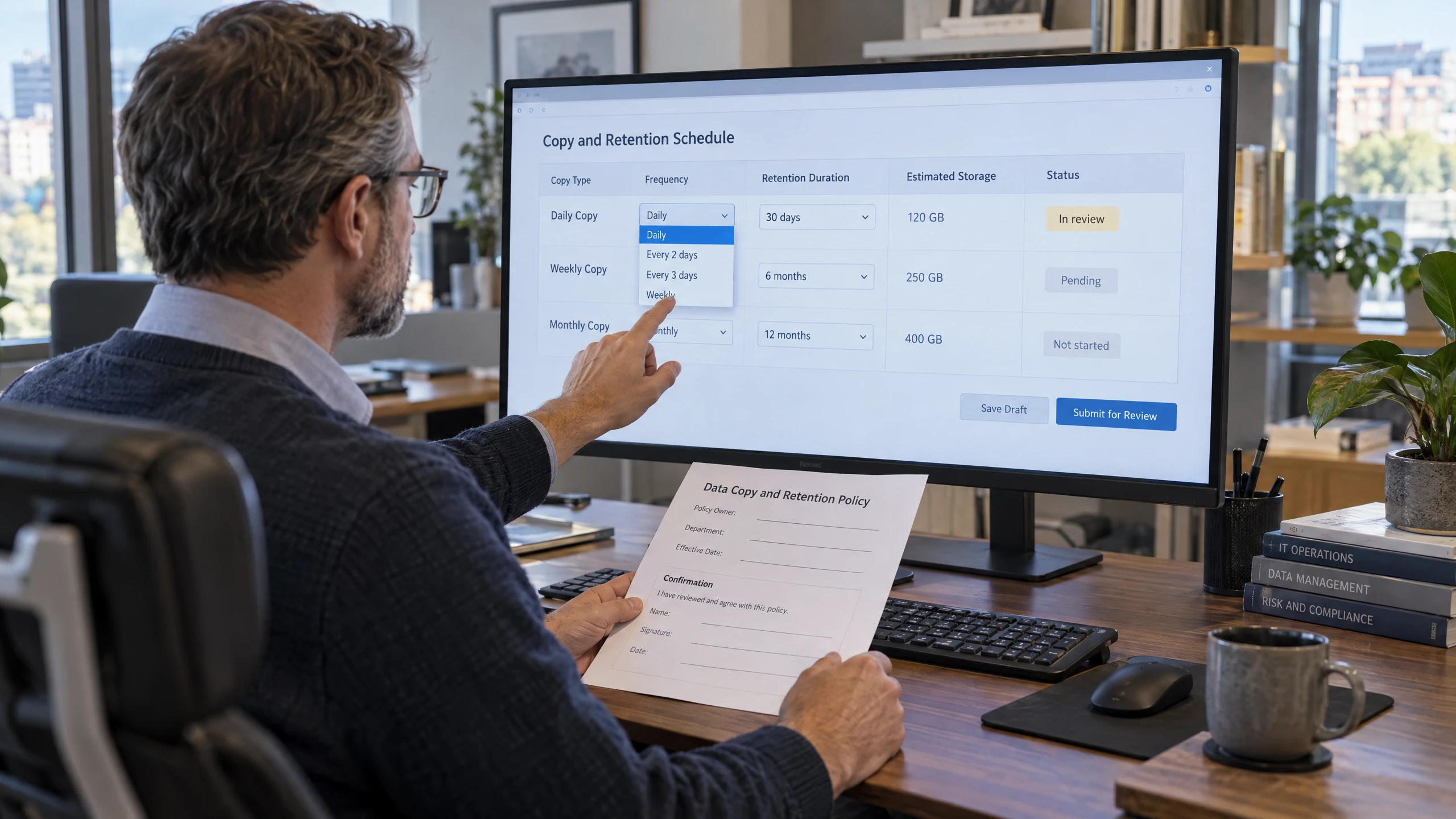
Document proposed copy frequency and how long recoverable copies should be retained.
Retention and frequency should be matched to business priorities, risk and available design options. No frequency, unlimited retention, compliance outcome or retention period is guaranteed, and native Microsoft 365 retention settings do not establish this profile's backup scope.Discuss this requirement
Define how a file, mailbox item, site or other agreed data set would be restored.
A proposed workflow should cover request approval, identity and access checks, destination choice, conflict handling and verification after restore. The actual restore targets, permissions and operator responsibilities must be confirmed for the agreed scope.Discuss this requirement
Exercise agreed restore scenarios and record what the results show.
Testing can be proposed for representative files, messages, sites or other included workloads, subject to access and agreed procedures. Test frequency, evidence, success criteria and follow-up ownership are not guaranteed and must be confirmed.Discuss this requirement
Clarify who owns decisions, access, restore execution and recovery communications.
The proposed scope should name the customer-side data owner, authorised requesters and the party responsible for carrying out or coordinating a restore. It should also state what happens when Microsoft, a software provider or another existing supplier owns part of the dependency.Discuss this requirementYour workplace, systems and operating requirements are the starting point for a useful technology discussion.
This page does not state that vCloud has a local office, a daily local roster or pre-confirmed on-site availability. Suitability and any delivery arrangements are confirmed after reviewing your requirements.
Microsoft 365 Backup is proposed as a distinct copy-and-recovery discussion, not general Microsoft 365 administration and not a substitute for native retention settings. The data selected, copy method and recovery responsibilities must be confirmed for each organisation.
This proposed profile is not general Microsoft 365 administration. It focuses on recoverable copies, restore procedures, tests and ownership. Microsoft 365 administration, tenant configuration, user support and native retention governance remain separate considerations unless expressly included in a confirmed scope.
Microsoft's Purview retention documentation describes retaining or deleting content in place for governance and eDiscovery, including secured workload locations; that native retention function is not the same as a separately scoped backup copy and restore service. A backup discussion should therefore record the intended recovery use, not treat a retention policy as proof of an independent backup.
For a Ebbw Vale, QLD organisation, access, authorisation, data sensitivity, existing providers and any hands-on or remote delivery arrangement should be reviewed before work is proposed. Restore availability, response, recovery time, testing cadence and service commitments require confirmation and are not established by this profile.
Remote support for Microsoft 365 Backup lets your team discuss service questions and issues without assuming an office visit is needed.
We can discuss remote access, the issue or requirement, and the information needed to investigate it safely.
The discussion can stay focused on your Microsoft 365 Backup setup, the issue you are experiencing and the access needed to investigate it remotely.
Remote access, scope and timing can be confirmed when you contact us.

Bring the detail that affects your people, systems and decisions into one practical discussion.
Separate the proposed recoverable-copy scope from Microsoft 365 administration, native retention and unrelated continuity work.
A written inclusion and exclusion list makes it easier to see what has been discussed rather than assuming every Microsoft 365 workload is covered.
Document who can request, approve, perform and verify recovery for the data included in the agreed scope.
Recorded exercises can show whether agreed restore steps and access arrangements work for the selected scenarios.
Feedback from our clients.
I have known Trevor for over 10 years and every time I have reached out with an issue, him and his team have always helped. vCloud helped with setting up my email, importing email and scan to email, which has never failed. Always a phone call away.
Different working environments bring different systems, rhythms and priorities into focus.

Dispatch, warehouse records and people working away from the office depend on connected information. Discuss access, communications and recovery priorities alongside the specialist systems used to track orders and deliveries.
Read perspective
Creative files, client projects and distributed teams need coordinated access. Consider storage, collaboration and recovery alongside the design applications and cloud platforms your agency relies on, without splitting ownership across unrelated suppliers.
Read perspective
Client records, communications and advice platforms should be considered together. Discuss dependable access, staff permissions and business continuity without treating a generic technology package as proof of regulatory compliance.
Read perspectiveStraightforward answers to help you understand your options.
It is a proposed, separately scoped set of recoverable copies of agreed Microsoft 365 data. Workload coverage, retention, restore steps and ownership must be documented and confirmed before work begins; this does not promise availability or complete Microsoft 365 coverage.
No. Administration manages the Microsoft 365 tenant and users, while this proposal focuses on recoverable copies, restores and recovery testing. Any administration needed for the design must be identified and confirmed separately.
No. Microsoft Purview retention governs retaining or deleting content for governance, with retained content remaining in its original location and copies held in secured workload locations. It does not by itself provide a separately scoped backup copy, independent restore workflow or guaranteed recovery coverage.
Coverage is proposed rather than assumed. The agreed scope should list the relevant mailboxes, files, sites, drives, groups, messages, versions and configurations, along with exclusions and technical limitations.
No copy frequency or retention period is promised. These choices depend on the proposed design, data priorities, risk, storage and agreed terms, and must be confirmed before relying on the service.
The scope should identify authorised requesters, the recovery decision-maker, the party performing or coordinating the restore and how the result is checked. Test frequency, success criteria, recovery time and any service commitments must be agreed rather than assumed.
Tell us what you need. We’ll help you understand the options and decide what comes next.
Use the enquiry form to tell us about your requirements.
Share the issue you’re facing, what you want to improve and any systems already in place.
We discuss your current setup, the people it needs to support and any practical requirements.
We explain suitable options and discuss the scope so you can decide how to proceed.
Tell us which Microsoft 365 data matters, what recovery scenarios concern your organisation and who should own restore decisions. We can discuss a proposed scope and identify the workload, retention, testing and delivery details that still need confirmation.